
GradientTools
Demonstrations.nb ››
Guide page ››
Code on Github ››
The main feature is an algorithm that uses static repulsion (Jones, Horsfield, and Simmons 1999; Froeling et al. 2017) to generate homogeneously distributed gradient directions for DWI experiments. It also provides functions to convert bval and bvec files to bmatrix and vice versa. Back››
Gradient design tool
Within QMRITools there is a function called GenerateGradientsGUI, this function allows to generate gradients tables compatible with the Philips MRI scanner. Since the list contains gradient directions and b-values in 4 separate columns it can easily be converted to other platforms such as Bruker, Siemens, Canon or GE.
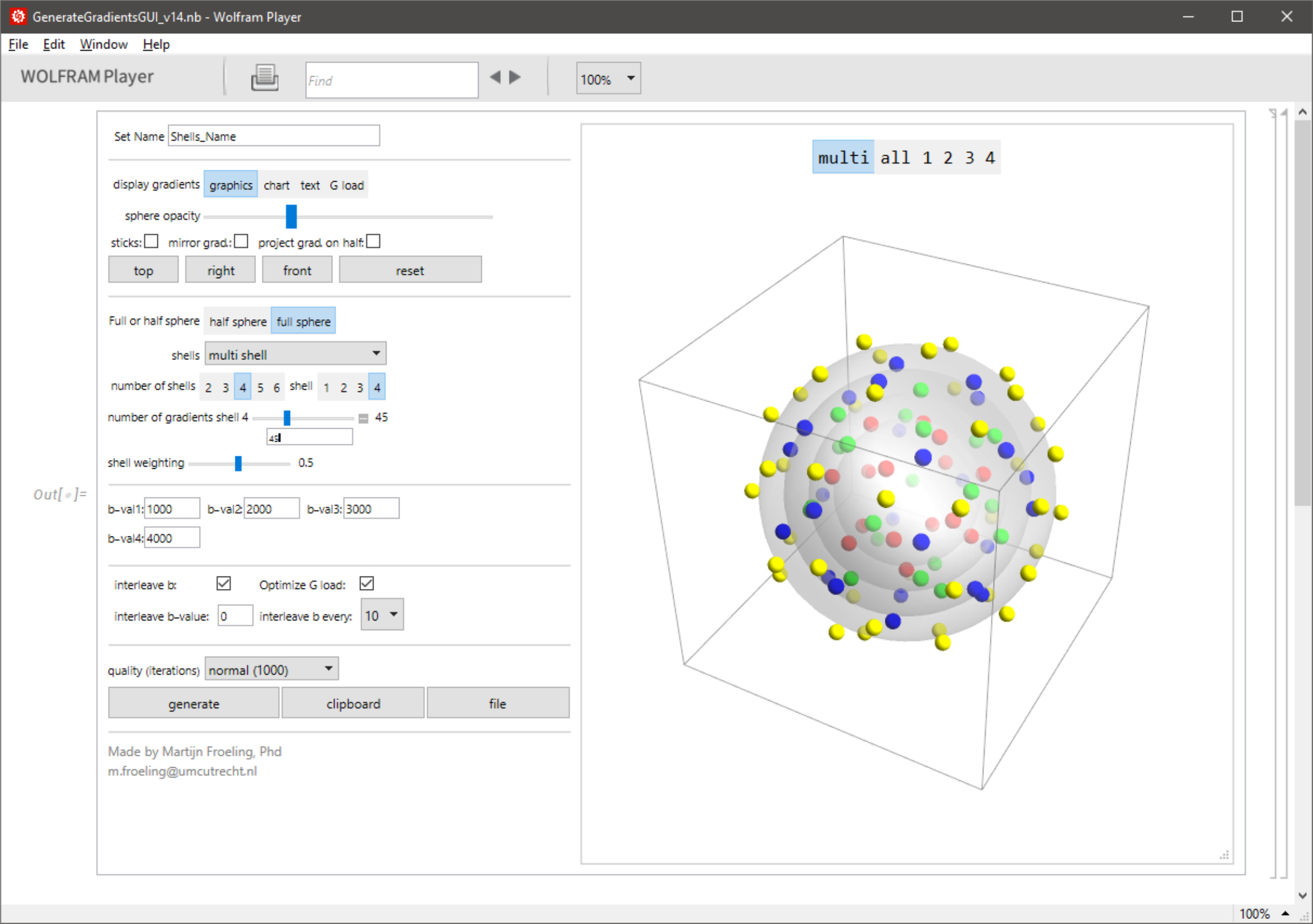
For those who do not have a Mathematica license and therefore cannot run the QMRITools paclet there is also a standalone version of the gradient optimizer that will run in Mathematica Player, which is free for everyone. The standalone notebook can be downloaded here (GenerateGradientsGUI_v14.nb), or from massive-data.org.
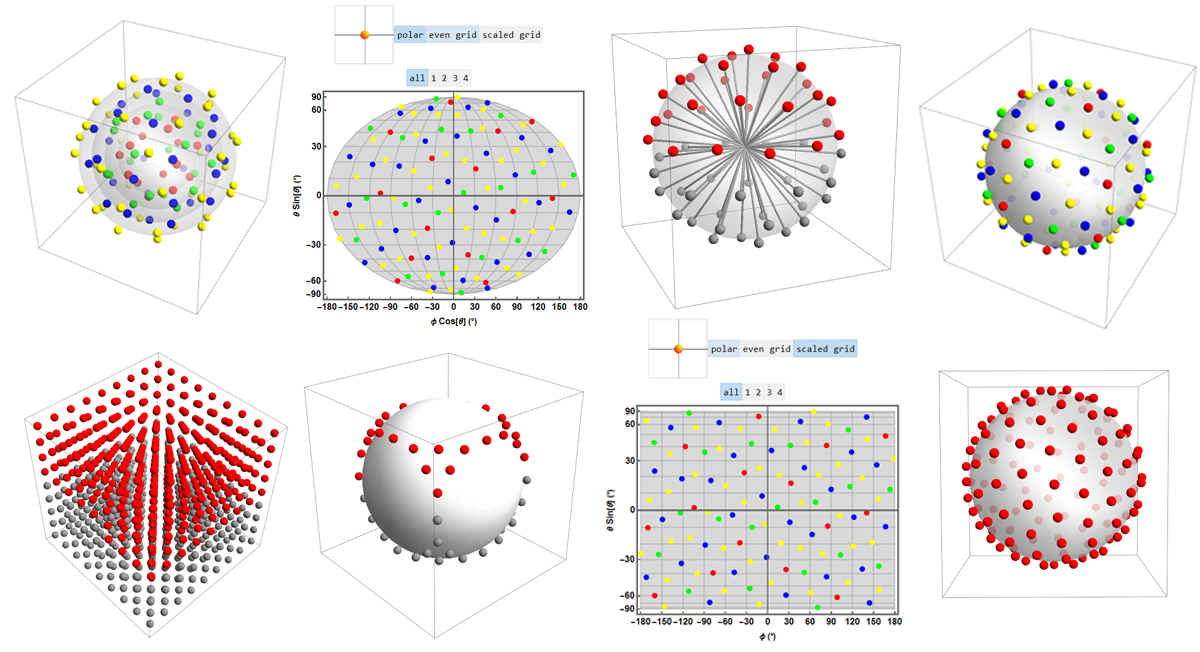
Features include
- single shell
- multi shell (variable shell weighting)
- cartesian grids
- ivim with orthogonal sampling
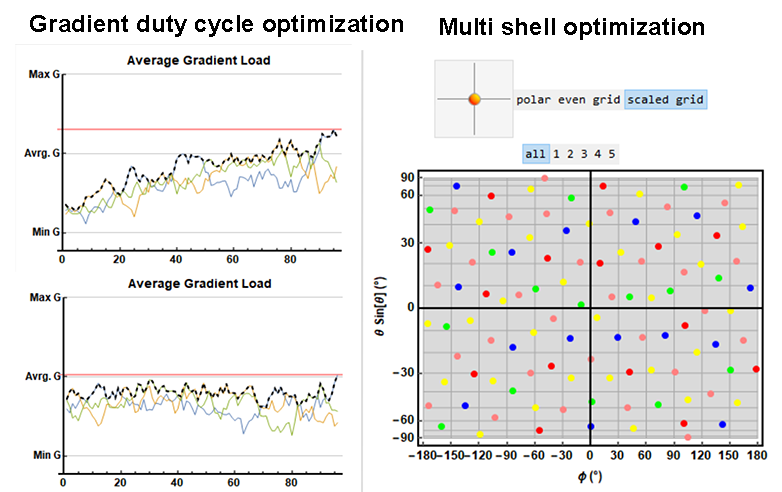
- gradient duty cycle optimization / randomization
- half and full shell optimization
- gradient visualization
- text file export
- interleaving of low or zero b-values
- polar plot of gradient direction
- gradient load visualization
- gradient “overplus” generation
References
- Froeling, Martijn, Chantal M. W. Tax, Sjoerd B. Vos, Peter R. Luijten, and Alexander Leemans. 2017. “MASSIVE brain dataset: Multiple acquisitions for standardization of structural imaging validation and evaluation.” Magnetic Resonance in Medicine 77 (5). Milan: 1797–1809. link››.